
How to Evaluate a Research Peptide Supplier in Canada
Comparing a research peptide supplier should begin with verifiable catalog details—not superlatives. Product identity, labeled strength, format, stock handling, batch identification, documentation language, and order policies all provide more useful evidence than a broad claim such as “premium” or “research grade” on its own.
1. Start with exact product identity
A useful product page makes the compound name and labeled amount obvious before a visitor reaches the description. The title, image, specifications, price, and stock status should describe the same item. This matters when a catalog carries several strengths of one compound, similarly named analogues, or blends with multiple components.
Check whether abbreviations are expanded where that improves clarity and whether a blend identifies each listed component. A product title should not force a researcher to infer whether the listing represents 5mg, 10mg, a combined total, or a multi-vial package.
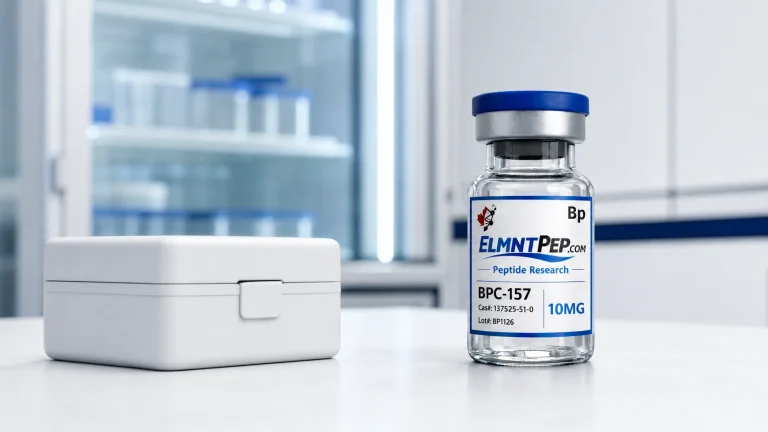
2. Confirm that the image matches the listing
A polished image is not enough if it shows the wrong compound or amount. Compare the visible label with the product title and specifications. When an image is illustrative rather than batch-specific, the surrounding page should still avoid creating a contradiction about identity, strength, or format.
Image consistency also helps catalog navigation. Similar aspect ratios, clean backgrounds, readable labels, and descriptive alternative text make it easier to compare products while supporting accessibility and image search.
3. Distinguish a single vial from a kit
Format should be explicit. Most ELMNTPEP peptide listings represent one vial unless the title says otherwise. The current HGH listing is a clearly named exception: HGH — 150 IU Kit (10 × 15 IU Vials). Stating the kit composition in the title prevents a ten-vial package from being mistaken for one 150 IU vial.
The same principle applies to blends. A combined amount should be identified as a total, with the component amounts stated on the product page rather than hidden in checkout notes.
A research starter kit should be equally explicit. The ELMNTPEP Retatrutide Starter Kit lists two Retatrutide 10mg vials, one ELMNTPEP Bacteriostatic Water 0.9% 20mL vial, and ten research syringes before checkout.
4. Look for live inventory and firm backorder controls
Availability should reflect orderable inventory. An out-of-stock product can remain public for comparison, but checkout should not silently accept a backorder unless the store has clearly explained the arrangement. A live stock state gives the customer a more accurate expectation and prevents unavailable products from appearing immediately orderable.
Inventory handling also affects search quality. Keeping an established out-of-stock product page available preserves useful product information and its URL history, while a correct OutOfStock offer status tells search engines and customers that the item cannot currently be purchased.
5. Read testing language precisely
Testing claims should be specific enough to evaluate. Useful documentation connects the named product or batch to an identifiable record and explains what information is currently available. A general purity percentage without a matching batch, method, date, or document is less informative than it first appears.
ELMNTPEP maintains a dedicated testing documentation page and a practical guide to reading peptide testing records and COAs. Published summaries are available in the peptide testing library; each record identifies the laboratory, date, reported results and scope. Compare each record with the supplied material rather than assuming catalogue-wide coverage.
6. Compare pricing, payment, and shipping before checkout
A professional catalog keeps the displayed price, cart price, and checkout total aligned. Payment choices should be named consistently across the site, and the checkout page should explain what happens after an order is submitted. ELMNTPEP currently supports E-Transfer and cryptocurrency checkout.
Shipping information should be accessible before payment. Review the destination coverage, promotion dates, tracking expectations, and any order-processing conditions on the store’s shipping page. Time-limited offers should show a clear end date rather than implying a permanent rate.
7. Expect clear research-use boundaries
A research catalog should not disguise medical, dosing, treatment, or administration advice as product education. Product pages can describe compound identity, commonly studied pathways, labeled amount, format, and analytical context without claiming that a product is approved, safe, or effective for personal use.
Review the supplier’s research-use policy and check whether the same boundary appears consistently on product pages, educational guides, checkout, and packaging. Consistent limitations are more credible than a disclaimer that conflicts with therapeutic marketing elsewhere on the site.
8. Evaluate the whole catalog, not one landing page
Consistency across dozens of listings is a stronger signal than one carefully written homepage. Search for several compounds, compare category placement, open both in-stock and out-of-stock products, and review the support and policy pages. Titles, strengths, photos, stock states, and research notices should follow the same system throughout.
It is also worth checking whether product and category URLs are stable, whether unavailable items remain clearly identified, and whether site search returns only customer-facing catalog records. Draft media, internal render tests, and private attachments should never appear in public results.
A practical comparison workflow
- Open the supplier’s full research catalog.
- Compare at least three product pages in different categories.
- Match every title to its image, labeled strength, format, and price.
- Check one in-stock and one out-of-stock product.
- Review testing, shipping, payment, refund, privacy, and research-use pages.
- Use site search to confirm that only customer-facing content appears.
- Choose the supplier whose details remain consistent across the entire path from catalog to checkout.
Browse research peptides in Canada by category, labeled strength, live stock, price, and clearly stated format.
Unlock the free research reference with your email and keep a concise compound-and-category guide on hand.
Put the checklist into practice
The ELMNTPEP peptide testing library brings published results together by compound, report identifier and laboratory. Open the summary, compare the tested amount with the product label, and ask for the connection to the lot being supplied.
Records marked Reference test cover another strength or format. They provide context but do not verify the listed strength. A supplier-prepared summary should also remain distinguishable from the laboratory-issued report; branding alone does not establish manufacturer identity or batch traceability.
Research use notice: This guide is provided for supplier and catalog evaluation in a laboratory-research context. It does not provide medical, dosing, administration, or therapeutic guidance. ELMNTPEP products are not intended for human or veterinary use.