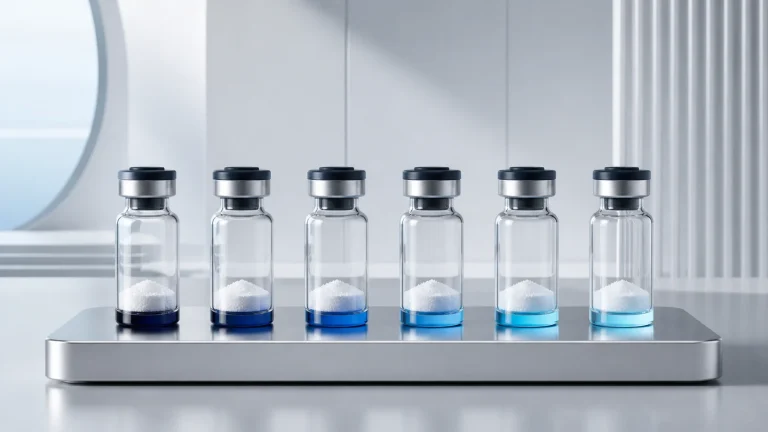

GLOW vs KLOW: A Research Blend Comparison
GLOW and KLOW are fixed multi-component research blends with the same three-compound base. The defining catalog difference is precise: KLOW adds KPV 10mg to the GLOW composition, increasing the labeled total from 70mg to 80mg. That additional component also adds another variable to identity testing and experimental interpretation.
- GLOW 70mg: GHK-Cu 50mg + BPC-157 10mg + TB-500 10mg.
- KLOW 80mg: the same labeled amounts of GHK-Cu, BPC-157, and TB-500, plus KPV 10mg.
- Defining difference: KLOW contains one additional named tripeptide; it is not merely a higher-strength GLOW vial.
- Research implication: each blend is a fixed mixture whose components, ratios, analytical signals, and controls must be considered together.
GLOW vs KLOW composition at a glance
| Labeled component | GLOW Blend — 70mg | KLOW Blend — 80mg |
|---|---|---|
| GHK-Cu | 50mg | 50mg |
| BPC-157 | 10mg | 10mg |
| TB-500 | 10mg | 10mg |
| KPV | Not listed | 10mg |
| Total labeled amount | 70mg | 80mg |
| ELMNTPEP listing | View GLOW Blend | View KLOW Blend |
KLOW is GLOW plus one named component
The first three labeled amounts are identical across the two ELMNTPEP listings. KLOW adds KPV at 10mg, producing a four-component 80mg total instead of the three-component 70mg total. A laboratory record should therefore identify the blend name, every stated component, each labeled amount, the total amount, and the batch identifier.
The difference should not be summarized as “stronger” or “better.” More components do not establish superior performance. The additional material changes the composition and expands the number of analytes, controls, interactions, and alternative explanations in the study.
A fixed blend answers a different question from separate components
A single-vial blend fixes the relative labeled amounts before the experiment begins. That can be appropriate when the research question concerns the supplied formulation itself. It is less informative when the objective is to attribute an observation to one component, because the individual variables are not independently separated inside that material.
Mechanistic work is cleaner when the design includes the complete blend, vehicle control, relevant single-component controls, and any intentionally selected sub-combinations. Without those comparators, an observation associated with the mixture cannot establish which material contributed to it or whether the mixture behaved differently from its isolated components.
What the component literature can—and cannot—establish
Primary studies provide context for individually defined research materials. Maquart and colleagues evaluated GHK-Cu in rat wound chambers and measured extracellular-matrix-related endpoints. Huang and colleagues examined Cu-GHK with LED photoirradiation in cultured human fibroblasts using viability, collagen-related, and growth-factor measurements.
For BPC-157, Huang and colleagues used a rat alkali-burn model and human umbilical-vein endothelial cells, with histology, migration, proliferation, tube-formation, and signaling endpoints. Those methods belong to the specified models and test article; they do not validate a commercial blend.
Thymosin beta 4 literature often appears beside catalog discussions of TB-500. These names should not be assumed to identify the same sequence. Malinda and colleagues studied thymosin beta 4 in a rat full-thickness wound model and a keratinocyte migration assay. Applying that literature to a product labeled TB-500 requires confirmation of the supplied sequence and form.
KPV has its own literature. Dalmasso and colleagues investigated KPV uptake through the PepT1 transporter in intestinal epithelial and immune-cell systems and used two mouse colitis models. That work provides a defined preclinical context for KPV. It does not test the four-component KLOW formulation.
Component evidence is not blend evidence
A study of GHK-Cu, BPC-157, thymosin beta 4, or KPV alone does not demonstrate the identity, stability, compatibility, or combined activity of GLOW or KLOW. The complete blends are vendor-defined formulations, and each combined material should be treated as its own test article.
When reviewing any mixture claim, ask whether the cited paper used the same components, sequences, chemical forms, relative amounts, preparation, model, and endpoints. If it did not, the paper may supply background for one component but cannot be presented as direct evidence for the blend.
Analytical identity becomes more demanding in a mixture
A multi-component chromatogram or mass spectrum must distinguish several expected analytes and possible related species within one sample. Signal overlap, ion suppression, co-elution, copper-complex behavior, degradation products, and large differences in labeled component amounts can complicate interpretation.
An appropriate method should identify every claimed component rather than inferring the entire mixture from one dominant peak. The documentation should make clear whether a result applies to the finished blend, an individual component before blending, or both. Those are different evidence layers.
Seven checks before comparing GLOW and KLOW
Record every named material and its labeled amount.
Confirm sequences, modifications, and chemical forms rather than relying on nicknames.
Verify that the analytical method addresses the combined sample.
Use relevant isolated materials when attribution is part of the question.
Do not infer an independently optimized component relationship from a vendor-defined ratio.
Connect the vial, documentation, and experimental record to the same batch.
Compare current price and availability on the product pages; backorders are disabled.
Documentation and handling complete the comparison
Use the testing documentation guide to review identity, method, specification, result, date, batch reference, and report authorization. Browse the testing library for published report summaries. Check each record’s tested amount, date and scope; a summary alone does not establish that current inventory is the tested lot.
Use the research peptide storage and handling checklist to record receipt, label condition, storage state, opening, preparation, aliquots, and any excursion. Product-specific documentation should take precedence over a generic assumption applied to every component.
Primary research references
- Maquart et al. (1993) studied GHK-Cu in rat wound chambers and measured connective-tissue accumulation and related molecular endpoints.
- Huang et al. (2015) investigated BPC-157 in a rat alkali-burn model and human endothelial-cell assays.
- Malinda et al. (1999) evaluated thymosin beta 4 in a rat wound model and keratinocyte migration assay.
- Dalmasso et al. (2008) investigated KPV uptake and signaling in cell systems and two mouse colitis models.
Review exact compositions, labeled strengths, current stock, pricing, and single-vial formats.
Explore every ELMNTPEP research comparison
Research use notice: This article provides educational catalog, analytical, and literature context. It does not provide medical, dosing, administration, performance, or therapeutic guidance. ELMNTPEP products are intended for laboratory research use only and are not for human or veterinary consumption.