BPC-157 Research Guide: Sequence, Evidence, and Limits
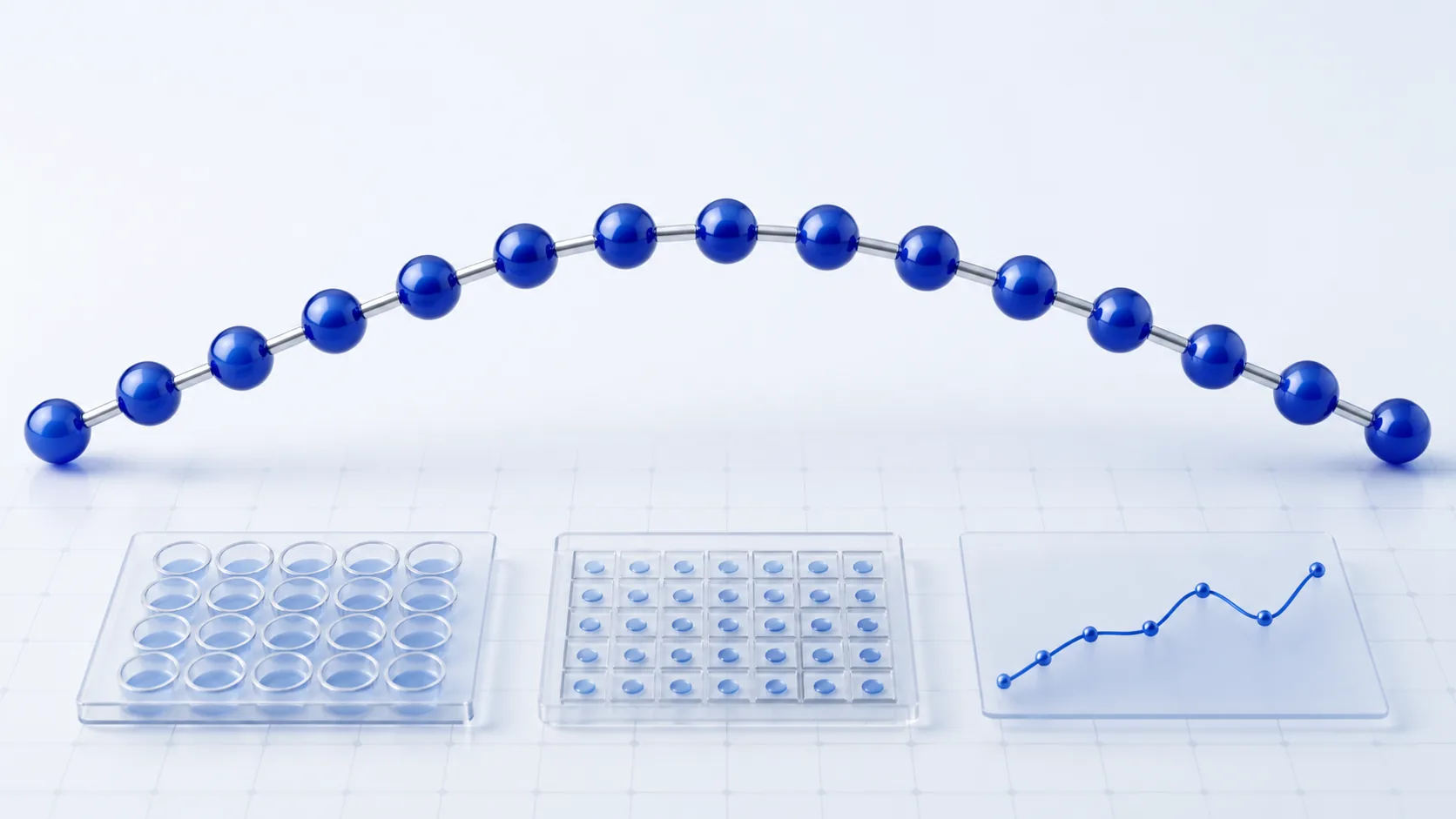
BPC-157 is a synthetic 15-residue peptide studied primarily in cell systems and animal models. Online summaries often compress those findings into a human “healing” claim, but that skips the most important scientific questions: what molecular form was tested, which model and endpoint were used, how identity was established, and whether the evidence can be translated beyond that experiment.
- Length: 15 amino-acid residues.
- PubChem sequence: GEPPPGKPADDAGLV.
- Common research systems: cultured tendon fibroblasts, endothelial-cell assays, and rat tissue-injury models.
- Evidence boundary: a cell or animal result does not establish clinical safety or effectiveness in people.
- Catalog boundary: a labeled research vial is not an authorized injectable drug or the test article from a cited publication.
What is BPC-157?
PubChem identifies BPC-157 under CID 9941957 and lists the sequence Gly-Glu-Pro-Pro-Pro-Gly-Lys-Pro-Ala-Asp-Asp-Ala-Gly-Leu-Val. The shorthand sequence is GEPPPGKPADDAGLV. It is commonly described in the literature as a pentadecapeptide associated with a proposed gastric “body protection compound” sequence.
The name alone is not a complete analytical identity. A laboratory record should distinguish the expected sequence, terminal form, counterion or salt form, molecular mass basis, and any other stated modification. Those details matter because two products using the same nickname may not represent the same molecular material.
Sequence identity comes before biological interpretation
A 15-residue label claim can be evaluated at several levels. Mass-based evidence can support agreement with an expected molecular mass, while chromatographic methods can separate the main analyte signal from selected related species under stated conditions. Neither measurement, by itself, establishes quantity, sterility, biological activity, or clinical suitability.
Confirm the intended residue order and whether the listed form specifies free termini or another terminal state.
Record the stated chemical form. Free-base and acetate nomenclature should not be silently treated as interchangeable.
Clarify whether a reported amount refers to peptide, salt, total vial contents, or another stated basis.
Use complementary methods when the research question requires more than a single chromatographic or mass result.
BPC-157 free base and acetate are distinct descriptions
Regulatory and compounding discussions often identify BPC-157 free base and BPC-157 acetate separately. That distinction is a useful reminder for research procurement: the exact form should be stated in the product specification and matched to the analytical method. A report for one form should not be assumed to establish the identity or amount of another.
Counterion content can also affect how a mass or percentage is expressed. The documentation should explain the analyte, reference basis, calculation, specification, and result rather than presenting one unsupported “purity” percentage as a complete quality conclusion.
Four evidence layers that should not be collapsed
| Evidence layer | What it can address | What it cannot establish alone |
|---|---|---|
| Analytical characterization | Identity, separation profile, or quantity for the tested sample and method. | Biological activity, sterility, safety, or effectiveness. |
| Cell and ex-vivo assays | Defined endpoints such as migration, survival, signaling, or explant outgrowth. | Whole-organism exposure, clinical outcomes, or human safety. |
| Animal models | Selected functional, histological, biochemical, or pharmacokinetic endpoints in a species and protocol. | Human benefit, validated dosing, or authorization as a medicine. |
| Human clinical evidence | Protocol-specific safety or efficacy questions when adequately designed and completed. | Identity or equivalence of an unrelated commercial research vial. |
What tendon-fibroblast studies actually measured
Chang and colleagues examined explants and fibroblasts derived from rat Achilles tendons. Their 2010 study reported faster explant outgrowth, increased cell survival under hydrogen-peroxide stress, and changes in migration, spreading, F-actin formation, and FAK/paxillin phosphorylation. It also reported that BPC-157 did not directly increase proliferation in the cultured tendon fibroblasts under the stated MTT assay.
A later study from the same research group measured growth-hormone-receptor expression and downstream responses in rat tendon fibroblasts. These are mechanistic cell-system observations. They do not demonstrate that a retail vial repairs a human tendon, and they should not be rewritten as a clinical recovery guarantee.
What vascular and wound-model studies measured
Huang and colleagues studied a rat alkali-burn model alongside human umbilical-vein endothelial-cell assays. Endpoints included wound closure, histology, collagen-related measurements, cell proliferation, migration, tube formation, and ERK1/2-associated signaling. Hsieh and colleagues used a rat hind-limb ischemia model and endothelial-cell assays to examine blood-flow recovery, vessel-related endpoints, VEGFR2 expression and internalization, and downstream signaling.
Those studies provide model-specific hypotheses about endothelial and signaling responses. The methods, test-article form, exposure conditions, species, and endpoints constrain every conclusion. A result from an endothelial-cell plate or rat model is not direct evidence of safety or therapeutic performance in people.
Pharmacokinetic work is also species- and method-specific
A 2022 pharmacokinetic study evaluated BPC-157 in rats and beagle dogs. The investigators reported a prototype elimination half-life below 30 minutes after the studied administrations and characterized distribution, metabolism, and excretion in those species. That finding should not be converted into a human dosing schedule. It is preclinical pharmacokinetic evidence tied to the reported material, species, route, sampling design, and analytical method.
Canadian regulatory context
Health Canada’s April 9, 2026 public advisory lists BPC-157 among examples of unauthorized injectable peptide drugs and advises consumers not to buy or use unauthorized peptide drugs. The advisory also states that “For Research Use Only – Not for Human Consumption” labeling does not make a product legal or exempt it from regulatory requirements when it is marketed or used as a health product.
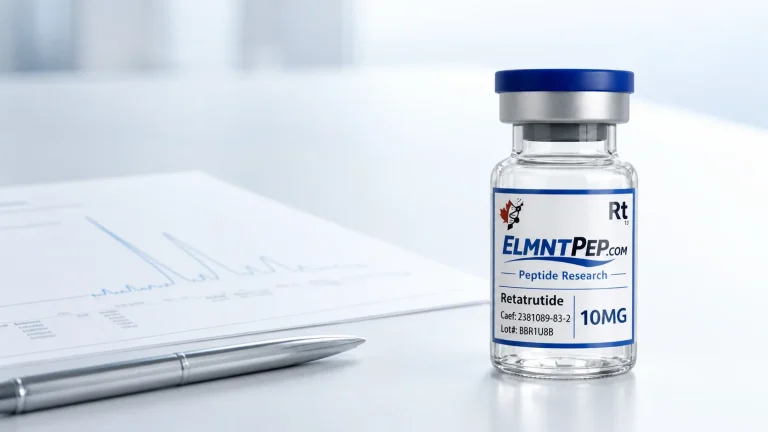
ELMNTPEP catalog listings are presented as laboratory research materials, not authorized therapeutic products. They do not carry a Drug Identification Number, do not provide administration instructions, and must not be interpreted as approval for injection, self-experimentation, or treatment. Anyone seeking medical care should use authorized products through an appropriately licensed healthcare professional and pharmacy.
BPC-157 formats in the ELMNTPEP catalog
| Listing | Labeled catalog format | Live record |
|---|---|---|
| BPC-157 — 5mg | One research vial labeled at 5mg | View current price and stock |
| BPC-157 — 10mg | One research vial labeled at 10mg | View current price and stock |
The milligram statement is a catalog label claim, not a dosing recommendation. Product pages are the authoritative source for current price and availability. Backorders are disabled, so an orderable listing must have live inventory.
Six checks before using BPC-157 in a laboratory study
Record sequence, termini, and stated free-base or salt form.
Connect the label, product record, report identifier, and experimental record to the same material.
Separate identity, chromatographic purity, quantity, sterility, and activity claims.
Select controls and endpoints that answer the stated laboratory question.
Do not convert cell or animal findings into human treatment claims.
Keep research procurement distinct from authorized medicines and clinical care.
BPC-157 is not TB-500
BPC-157 and products labeled TB-500 differ in named sequence, literature history, analytical target, and experimental context. Grouping both under a broad “recovery” label does not make them interchangeable. Review the BPC-157 vs TB-500 laboratory comparison for a method-focused distinction between the two catalog materials.
Documentation and recordkeeping
Use the testing documentation guide to review identity, method, specification, result, date, batch reference, and report authorization. Browse the testing library for published report summaries. Check each record’s tested amount, date and scope; a summary alone does not establish that current inventory is the tested lot.
Use the research peptide storage and handling checklist to record receipt, label condition, storage state, preparation, aliquots, and excursions. Product- and method-specific documentation should take precedence over generic assumptions.
Primary and regulatory references
- PubChem CID 9941957 provides the BPC-157 sequence, molecular formula, identifiers, and computed descriptors.
- Chang et al. (2011) examined rat tendon explants and tendon-fibroblast survival, migration, spreading, and FAK/paxillin signaling.
- Chang et al. (2014) studied growth-hormone-receptor expression and associated responses in rat tendon fibroblasts.
- Huang et al. (2015) evaluated a rat alkali-burn model and human endothelial-cell assays.
- Hsieh et al. (2017) studied VEGFR2-associated signaling in a rat ischemia model and endothelial-cell systems.
- He et al. (2022) reported preclinical pharmacokinetics, distribution, metabolism, and excretion in rats and dogs.
- Health Canada (2026) provides the current Canadian consumer advisory concerning unauthorized injectable peptide drugs.
Compare exact product names, labeled strengths, current stock, formats, and documentation status.
Read the available BPC-157 testing record
BPC-157 report 137873 covers two 10mg vials, each measured at 10.57mg, with reported purity of 99.464% and 99.612%. Both vial results are retained in the summary.
This is a 10mg test record, not documentation for the separate 5mg listing. Confirm the lot connection before applying results to inventory. The COA reading guide explains how to check amount, purity and report scope separately.
Research use notice: This article provides educational molecular, analytical, literature, regulatory, and catalog context. It does not provide medical, dosing, administration, performance, or therapeutic guidance. ELMNTPEP products are intended for laboratory research use only and are not for human or veterinary consumption.