BPC-157 vs TB-500: A Laboratory Research Comparison
BPC-157 and TB-500 are frequently grouped together in recovery-research catalogs, but the names do not identify the same peptide, sequence, or body of literature. A useful comparison begins with molecular identity and the exact experimental material—not with the broad category in which a product appears.
- BPC-157 is described in primary research as a 15-amino-acid pentadecapeptide.
- Thymosin beta-4 is a 43-amino-acid peptide with a characterized actin-binding region.
- TB-500 is a catalog name that should be mapped to an exact sequence or supplied identity before literature is applied.
- A blend name does not establish interaction, synergy, or experimental equivalence.
BPC-157 vs TB-500 at a glance
| Comparison field | BPC-157 | TB-500 / thymosin beta-4 context |
|---|---|---|
| Catalog identity | Named pentadecapeptide | TB-500 naming needs sequence and documentation context |
| Primary-literature anchor | 15-amino-acid BPC-157 studies | Full-length 43-amino-acid thymosin beta-4 and defined fragments appear in the literature |
| Research systems in cited studies | Rat tendon explants and cultured rat tendon fibroblasts | Actin-binding assays and animal wound models |
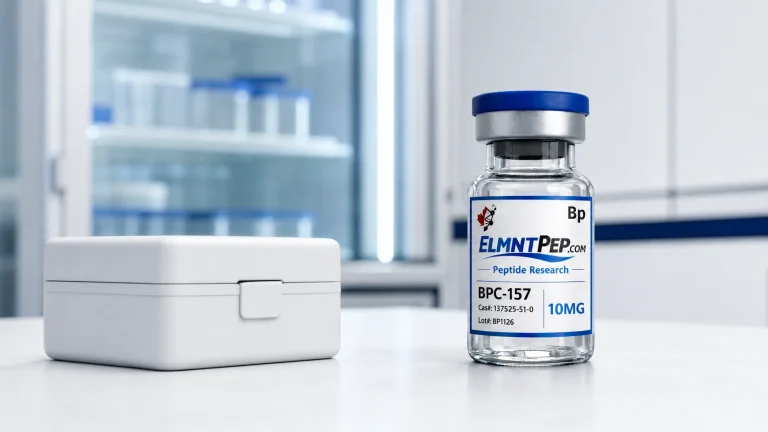
| ELMNTPEP listings | BPC-157 — 5mg and BPC-157 — 10mg | TB-500 — 10mg |
BPC-157 is a defined pentadecapeptide
BPC-157 is described in the research literature as a peptide composed of 15 amino acids. One primary study examined rat Achilles-tendon explants and cultured rat tendon fibroblasts. The investigators reported experimental observations involving outgrowth, cell survival under oxidative stress, cell migration, spreading, F-actin formation, and FAK-paxillin signalling in those systems.
Those details define the scope of the experiment. They do not establish a universal outcome, a human-use instruction, or the identity and purity of a commercial vial. A catalog listing still needs a matching product name, labeled amount, batch reference, image, and documentation status.
Thymosin beta-4 and shorter fragments are not interchangeable labels
Thymosin beta-4 is a 43-amino-acid peptide. Foundational biochemical work mapped its actin-binding region using peptide mimetics, and later animal research examined both full-length thymosin beta-4 and a defined synthetic sequence derived from its actin-binding domain. Those are related research materials, but they are not automatically the same test article.
This matters when reading the term “TB-500.” The catalog nickname alone should not be used to assume that every thymosin beta-4 paper tested the same sequence or format represented by a particular listing. Match the supplied product identity and documentation to the exact material described in the source paper before drawing an experimental comparison.
The cited experiments ask different questions
The BPC-157 study cited here used tendon explants and cultured fibroblasts from rats to examine defined cellular observations. The thymosin beta-4 literature cited here includes biochemical actin-binding work and mouse wound models. Differences in species, material identity, model, endpoint, concentration, and analytical method prevent a simple “which is better?” conclusion.
A rigorous comparison is therefore question-led. First define the biological or analytical endpoint. Then identify which exact peptide, sequence, control, assay, and source paper fit that question. Category placement and product popularity are not substitutes for experimental design.
What the Wolverine name does—and does not—mean
“Wolverine” is a catalog blend name used for a product containing BPC-157 and TB-500. It communicates the labeled components of the blend; it does not by itself prove interaction, synergy, stability after combination, or equivalence to the two materials studied separately.
ELMNTPEP lists Wolverine — 10mg as a separate product from the individual BPC-157 and TB-500 listings. Researchers comparing a blend with individual components still need component-resolved controls and methods suited to the exact study. A combined labeled amount should not be read as the individual amount of each component unless the product documentation states that breakdown.
Seven fields to compare before ordering
Use the product and literature name as the first identity check.
Distinguish full-length peptides, fragments, analogues, and blends.
Confirm the amount stated for the single vial or entire blend.
Identify whether the listing is one compound, a blend, or a kit.
Connect the physical vial to the relevant catalog and documentation record.
Use current availability; ELMNTPEP does not accept backorders.
Verify that the label image agrees with the name and amount.
Documentation should answer product-level questions
Literature and product documentation do different jobs. A peer-reviewed paper describes a study material, model, methods, and findings. Product documentation addresses the catalog material and associated batch. One cannot replace the other.
When documentation is available, check the compound name, batch identifier, analytical method, result, specification, date, and report authorization. The peptide testing documentation guide explains those fields in more detail. Browse the testing library for published report summaries. Check each record’s tested amount, date and scope; a summary alone does not establish that current inventory is the tested lot.
Storage records preserve the comparison after receipt
A correct catalog selection can still become an uncertain sample if its receiving and handling history is incomplete. Record the label, batch, arrival condition, storage state, opening, preparation, aliquots, and any excursion. Use the research peptide storage and handling checklist to build a traceable workflow without assuming one universal condition or shelf life.
Primary research references
- Chang et al. (2011) examined BPC-157 in rat tendon explants and cultured tendon fibroblasts, including cell migration, survival under stress, and FAK-paxillin signalling.
- Vancompernolle et al. (1992) mapped actin-binding sites in thymosin beta-4 and related peptide mimetics.
- Philp et al. (2003) studied full-length thymosin beta-4 and a defined synthetic actin-binding-domain sequence in animal wound models.
Review exact product names, labeled strengths, formats, live inventory, and documentation language.
Explore every ELMNTPEP research comparison
Research use notice: This article provides educational catalog and literature context. It does not provide medical, dosing, administration, injury, or therapeutic guidance. ELMNTPEP products are intended for laboratory research use only and are not for human or veterinary consumption.